
Town of Union Resident Lookup Records
Each record in a Town of Union resident lookup has a narrow purpose. Property sources connect an owner of record to a parcel. A tax bill is tied to a billing year. A deed records a conveyance. A court index can identify an eligible case, while a vital record can support an event or family relationship. Use more than one custodian before treating a match as meaningful.
| Record | What It Confirms | Where | Access |
|---|---|---|---|
| Assessment or parcel record | Owner of record, mailing address, assessment, parcel details | Broome Image Mate and GIS | Public reference, not proof of occupancy |
| Tax bill | Billing name, map number, address, bill number | Union TaxLookup | Search by address, owner, map, or bill; year matters |
| Recorded deed | Parties, date, and legal parcel description | Broome land index | Modern land index and images have separate historical coverage |
| Voter self-check | A registered voter’s own registration match | New York voter search | Identity fields required; a non-match proves little |
| Vital record | Event or relationship information | Town Clerk or New York State Department of Health | Confidential, with eligibility and time rules |
| Court record | Eligible case, court, date, and case number | New York eCourts or clerk | Case-type dependent; some material is excluded |
Start with the source closest to the question. An ownership question belongs with the parcel and deed trail. A relationship question may call for an eligible vital record or an older directory. A current registration question is limited to the registered voter’s own state lookup. Town of Union property owner and mailing fields do not prove that the named person occupies the address.
Town of Union Name Match Checks
Match a full name with two independent details. Good pairings include a name and parcel ID, a name and deed date, or a name and an old directory street plus year. Preserve initials, apostrophes, hyphenation, middle names, and alternate spellings. A record can name a trust, estate, developer, or corporation instead of a person, so first decide what kind of party the record identifies.
The Town of Union also appears under postal and local names such as Endwell, Endicott, Johnson City, West Corners, Union Center, North Endicott, West Endicott, Fairmont Park, Westover, and Choconut Center. Check the municipality field instead of assuming a postal label settles the question. Date every observation. An old directory can support a historical address, but it cannot become a current resident list without an independent current source.
Note: A portal result that does not match can reflect a move, a spelling difference, limited coverage, or a protected record.
Town of Union Court Lookup Routes
New York eCourts is a group of routes, not one universal docket. WebCivil Local, WebCivil Supreme, WebCriminal, WebFamily, eTrack, and NYSCEF serve different case types. Use the court and case type first, then record the case number, date, and result that appear. The official tools are useful leads, but the live field labels vary by route and should be checked at the time of search.
An absent online result is not a finding that no case exists. The state identifies sealed, youthful-offender, adoption, delayed-entry, and other restricted or excluded matters as reasons information may not appear. For a Town of Union Justice Court matter, research found no public online docket. Call the clerk at 607-786-2965 with the full name, approximate date, case type, and any known case number, then ask what may be inspected or copied.
For estate matters, Broome Surrogate’s Court, not the County Clerk, is the route for wills and probate. A divorce certificate is the limited document available to a nonparty, while the full decree or judgment is restricted to a party, attorney, or person with a court order.
Published Broome Supreme decisions have their own state search route and reach back to 2001, but a posted opinion is not the same thing as a complete docket. Record the court name and case number before asking a clerk for a copy. For federal matters tied to Binghamton, PACER is a separate Northern District of New York system. A name-only result can include another person with the same name, so compare the district and case number before relying on it.
Town of Union Vital Record Proof
Vital records confirm events and relationships, not a present address. For a Town of Union birth or death, begin with the registrar where the event happened. For a marriage, begin with the municipality where the license was issued. The Town Clerk says local records are confidential and uses a written request from an immediate family member. A certified Town copy is listed at $10.
The Town Clerk’s official vital-record instructions show the local request route and form categories.
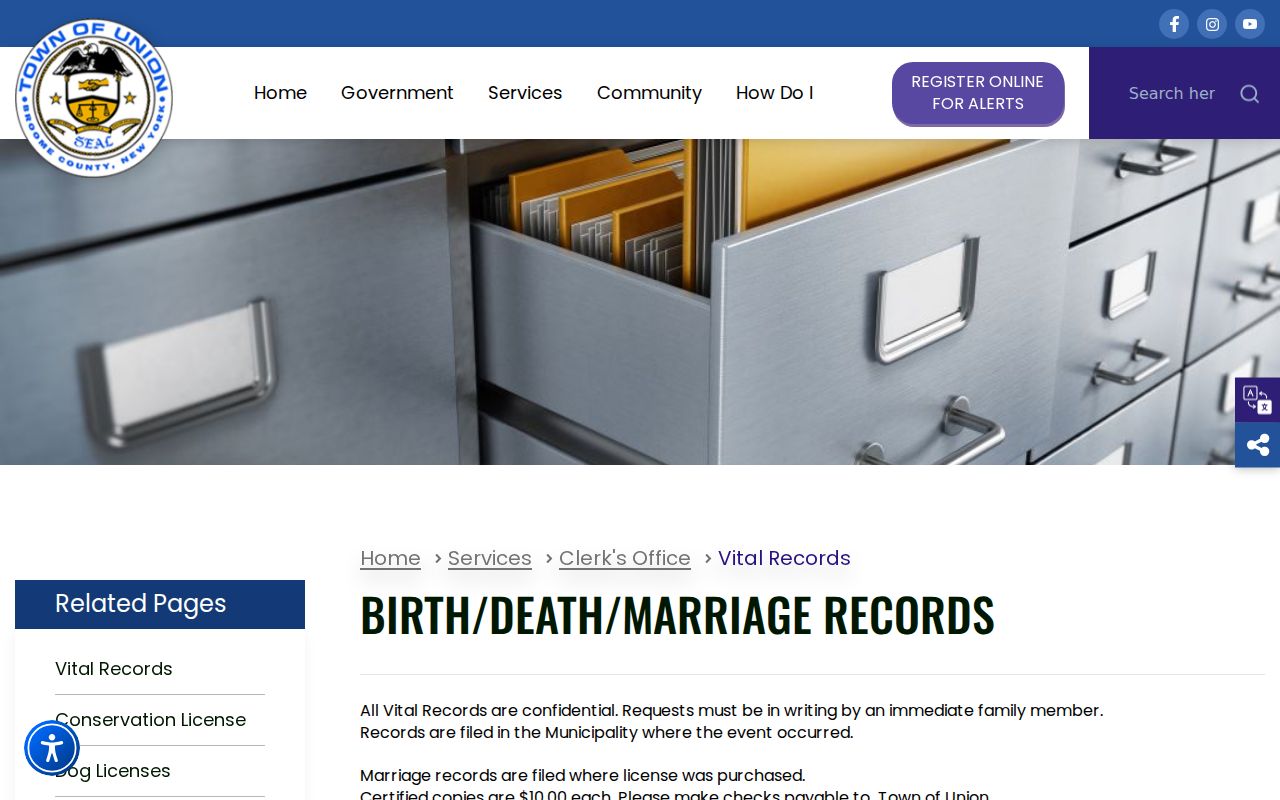
Use the form that fits the event and ask the clerk about current eligibility before sending payment or identity material.
For state genealogy research outside New York City, the Department of Health lists a birth period of 75 years with proof the person is deceased, a death period of 50 years, and a marriage period of 50 years with proof both parties are deceased. Direct-line descendants may qualify earlier with evidence. State genealogy processing may take eight months or more, so a dated local directory or archive index may be a useful companion while a request is pending. A state order and a Town request are separate routes, so send each to the custodian that holds the event record.
Verify a Town of Union Resident
Verification is strongest when the record trail stays explicit. Begin with a current parcel or tax result only if it supports the question, then carry the parcel key, owner name, or known document date to the next custodian. If the name is not the owner of record, stop short of an occupancy conclusion and use another lawful source appropriate to the time period.
- Search Image Mate or GIS with the precise name or address and save the parcel ID, municipality, and record date.
- Check the relevant TaxLookup year for the billing name, map number, and address, keeping the tax year with the result.
- Use the owner name, parcel reference, or deed date in the Broome land index, then compare the grantee and recorded date with the assessment record.
- For an eligible court, vital, or historical question, contact that separate custodian and ask for the record type or certified copy that its rules allow.
A useful result inventory has the person or party name, alternate spelling, parcel or case number, document or directory date, municipality, source URL, and the date checked. Those fields make it possible to revisit a match without copying excess personal detail.
- Docket
- A court’s case listing, usually organized around a case or index number and dated events.
- Index versus image
- An index points to a record. An image is a view of the document itself, and availability or copy rules can differ.
- Certified copy
- A copy issued by the custodian with its certification, available only when that office’s rules permit it.
Town of Union Custody Search Boundaries
Custody systems are not a Town of Union resident lookup. The official Broome Corrections page provides facility and contact information, but no live public county roster was located. The facility is in the Town of Dickinson, and a county contact response should not be read as evidence of a Town of Union address.
Broome Corrections is the factual fallback for custody questions, not a local resident list.
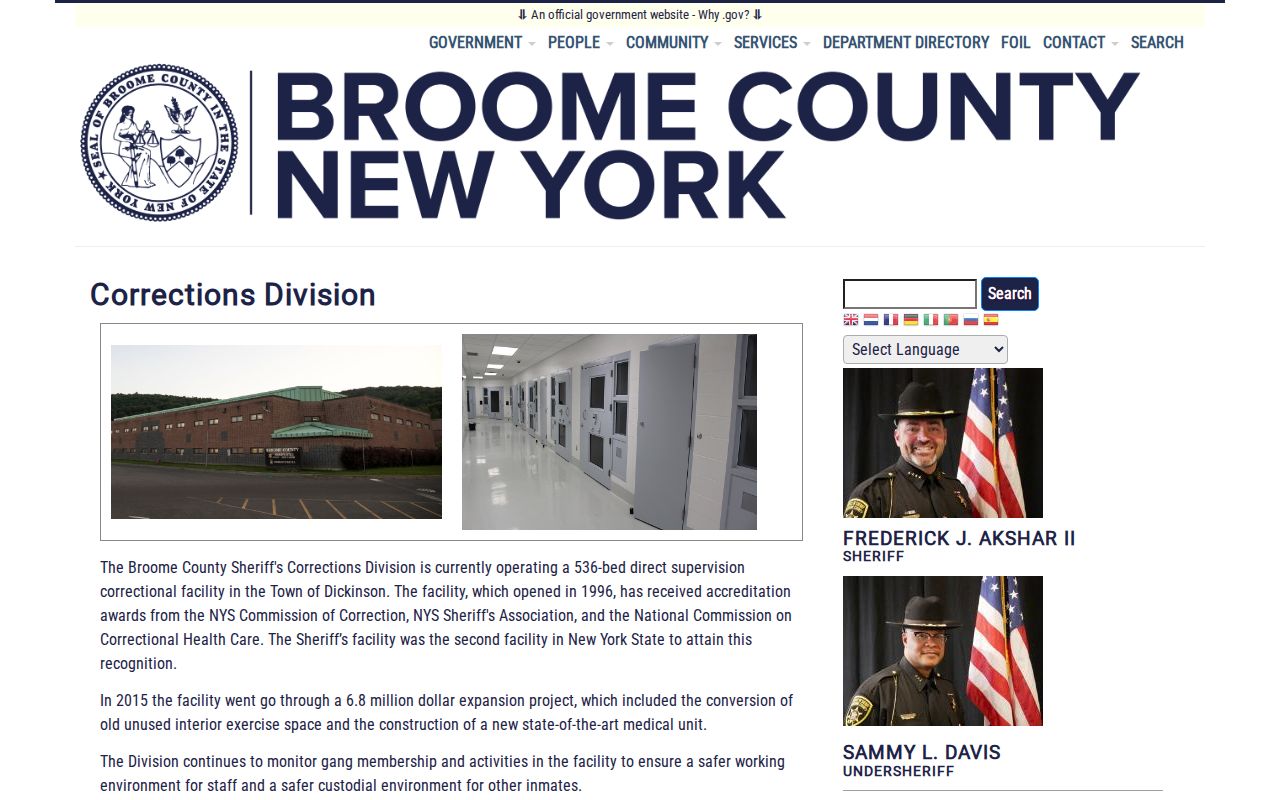
The page supports a direct contact route when a specific, lawful custody inquiry is appropriate.
For state custody, the New York DOCCS lookup uses name and birth-year routes, with DIN and NYSID as stronger identifiers. Its result describes state custody or release information, not current residence, and exclusions apply.
The DOCCS lookup identifies the state system and its search paths.
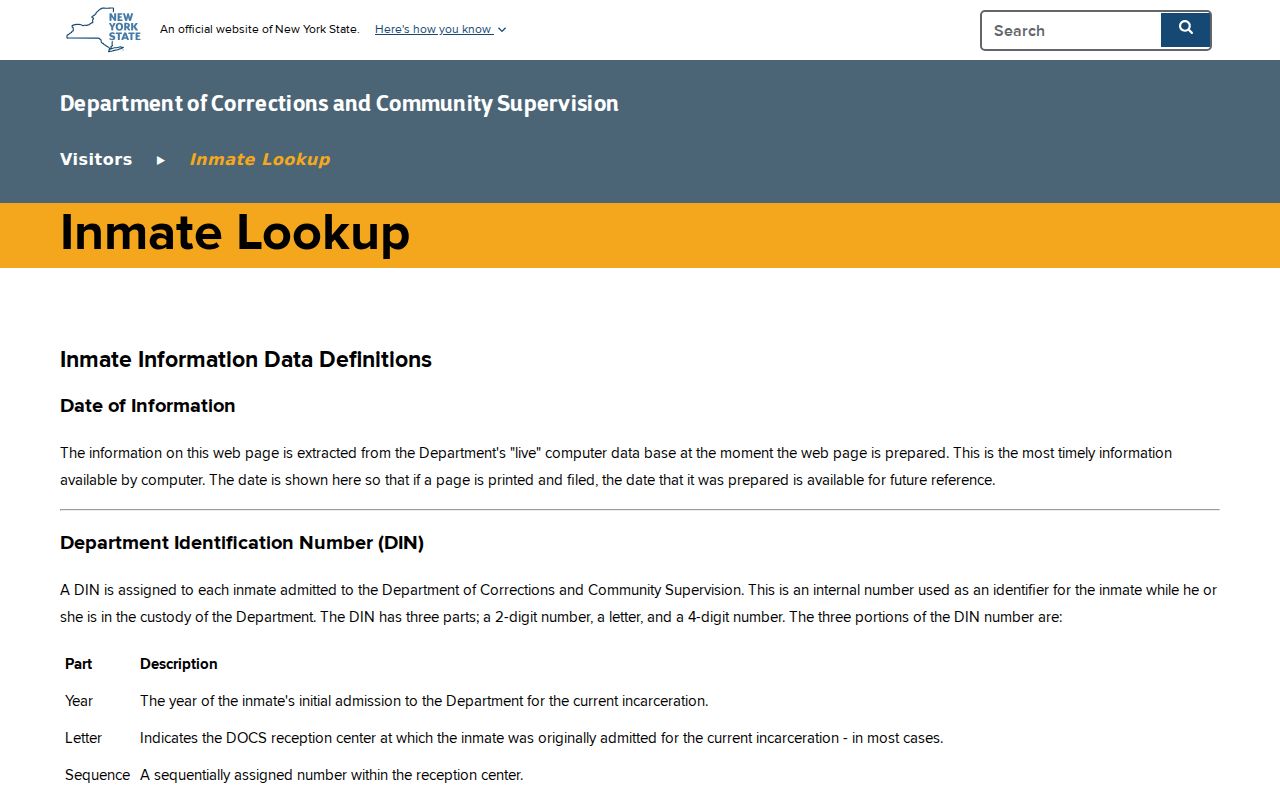
Keep any custody result separate from a residence question and verify it directly with the responsible agency.
Town of Union Lookup Privacy Protections
Some missing or partial records are intentional. New York’s Address Confidentiality Program can provide a substitute mailing address and protects the actual location for qualifying participants. Do not combine parcel, court, voter, or mailing fields to reverse-engineer that location. A confidential voter may also be absent from the ordinary public-facing lookup.
The voter self-check requires last name, first name, date of birth, county, address, and ZIP for a registered voter’s own verification. It is not a public list tool. A full voter-file request has a different rule: the State Board of Elections says the request must state an elections purpose under Election Law §3-103(5). For a registration issue, use the official state process or contact the Board of Elections rather than trying to build a name list from partial matches.
State business and professional searches answer a separate question as well. A service address or professional location can be public without being a home address. Correct an inaccurate local record with the custodian, and seek a certified document only through the office that controls it.
Town of Union Resident Lookup Limits
Use Town of Union records for personal, lawful research such as family history, reconnecting with a relative, checking a public filing, or understanding a parcel trail. Keep a source date and custodian name with any result. A name match, old address, case party role, or business location needs independent confirmation before it supports a conclusion about a person.
Lawful use. New York privacy rules and protected-record programs can limit access. Do not use records to stalk, harass, intimidate, or harm anyone, and do not try to defeat an address-confidentiality or confidential-voter protection.
Historical household questions have their own path through dated directory volumes, newspapers, and library material. For that work, the Town of Union city directory collections provide the stronger starting point than a current parcel screen.